
Data Federation is ETL. Maybe without the T but for sure with the outcome discarded afterward and calculated over and over.

Product marketing leverages the desires of people.
For many in IT getting rid of the complex ETL development, operations, and maintenance is one of these desires . Sometimes the business people shares this desire: to finally get free from the need to explain to non-business people (and sometimes challenge their own belief about) how the business works.
The data lakes in their original incarnation (in practices data swamps) promised to achieve this but didn’t live up to the promises.
There is also another solution, that didn’t suffer the same bad press, that promises to free the IT team from the need to have “complex ETL”: data virtualization/data federation.
In this post I’ll try to dispel two myths about data federation.

Myth 1: Data Federation removes the need to design complex ETL

ETL usually is not complex because of the tools used or a lack of skills.
The purpose of ongoing ETL is to extract new data from a number of source systems, manipulate it (clean, conform, track historical changes for slow changing dimensions, make hierarchies easier to use…) and produce new datasets that are useful for the business (i.e. data that enables the organization to make better and/or faster business decisions that will increase its profits).
The intrinsic complexity of the manipulation that needs to be implemented in the ETL is derived from the business processes: no tool will ever remove this complexity.
Intrinsic complexity can only be moved around, but never removed.
When a virtualization tool promises to “remove the complex ETL” what is really saying is “someone outside the ETL team will have to manage this complexity”: at best it is shifting the effort from one team to another within the organization. For example from the IT team to the business people. Or from the ETL team to the BI team within IT.
This is pretty much the same sleight of hand that was attempted with many of the early data lakes: store the data without much/any transformation.
The net result of many of the attempts was that the business users couldn’t utilize the data in these lakes in an efficient way. If at all.

Myth 2: Data Federation removes the effort needed to “run” the ETL

This is very true in the literal sense, but it is also very partial.
Replacing the ETL with a federation solution makes much harder to troubleshoot problems because intermediate datasets are not saved and available for review.
Because the data in the source systems is changing continuously it’s almost impossible to reproduce exactly the results the users complained about.
Ensuring in the federation approach a level of data quality comparable with what is achieved with the ETL can be cost prohibitive and the queries so slow that the user experience is unacceptable.
Extracting data from the source system during regular working hours adds load to the operational systems and also to the teams managing them.
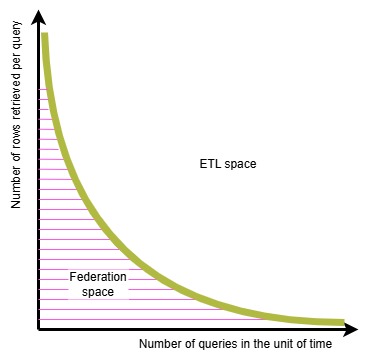
If the number of queries executed for the the specific use case is small, the data moved is modest, and there is not expectation of a significant growth in either dimension, you are safely in the “federation space“. If this is not the case then you must properly benchmark your solution and avoid a “kick the tire” test.

Conclusion

What you can get easily with a data federation solution is different from what you can get easily with an ETL solution.
Pretending this is not the case suggests a gap of knowledge and real-world experience.
The best solution is the one that addresses your organization’s (i.e. including the users’) needs with the most acceptable set of trade-off today and tomorrow.

P.S. In any case never challenge an experienced supporter of one of the two approaches: you can rest assured the person will find a very intricate, and costly, way to prove his tool of choice can do everything you say it can’t.
This is the reason why is purposely added the “easily” adverb in my conclusion.
Distributed Data Queries in Analytics: data caching and query push-down to the rescue?

I recently posted about the “federation space” and how there is a sweet spot for the use of data virtualization / data virtualization solutions to perform data analytics.
In the post I promised to discuss two optimization techniques that promise to extend the viability of running queries on distributed data.

Query push down

To anchor the discussion I’ll use a pseudo-code query.
The simplest query on distributed data can be sketched like this:
Select some_calculation from remote_table
For my example I’ll take “some-calculation” to be the average of the value of “column_a” in the remote table containing, let’s say, 10 rows with 10 columns per row.
– The most trivial implementation will perform the sample query by fetching the entire remote_table locally (100 values retrieved) then calculate the average.
– A slightly smarter implementation will push to the remote system the request to send across only the values of column a (10 values retrieved)
– A good, modern implementation will push the entire query to the remote system and retrieve only the desired average (1 value transferred across)

It all looks great in the simple example, but the reality of analytical queries is seldom this trivial.
A slightly more realistic pseudo query might look like the following:
Select customer from remote_spending_table, local_customers_segments_table where customer_spending>2[*average(all_foreign_customers_spending)] and customer_segment="foreign")
The purpose is to retrieve the list of foreign customers that are spending more than twice the average spending of the foreign customers
This generates two challenges:
1) correctly identify the extent of the possible query push down and translate it to the remote system’s SQL dialect (is already not trivial for this small example, just imagine with the 3000-lines-of-SQL generated by the MicroStrategy report of one of my German customers in 2010)
2) getting the owner of the remote system to agree on consuming its resources to execute our query.
Running a simple filter is much lighter than running an aggregation and it’s easier to get an agreement to it.

The second challenge is partly mitigated if the source in the cloud
Thanks to the cloud elasticity the negative impact in the source system can be made negligible or non-existent.
But the topic of who’s paying for the computing costs remains in place (unless it’s a single entity that pays for all the infrastructure costs).

Caching

As soon as a data virtualization project gets adopted the increased load on non-elastic on-premises source systems becomes unacceptable (because the original workload performance is negatively impacted) and the users of the analytics queries start to experience longer response times (because the source system is overwhelmed).
The solution to this challenge is to introduce a caching layer that will store a copy of (part of) the data near the data virtualization system. If properly sized the cache improves the user experience both for the source system’s users and for the people running the analytical queries.
The caching layer also helps reducing the egress costs when consuming data in a hybrid cloud setup. Microsoft’s Blog post about the introduction of S3 caching to OneLake just confirms it.

The first victim of caching is the vision of having “no data duplication (thanks to data virtualization)”, but it is not the only one.

Challenges of Distributed Data Queries in Analytics: the “federation space”

I joined Teradata in 2008.
At the time, inside the organization, the idea of using a data federation solution to run analytics workloads at scale, instead of a traditional ETL/ELT approach, was considered at best extravagant and in most cases plainly nonsensical.

With the arrival of Hadoop this attitude changed because a lot of organization felt IT finally had found the philosopher’s stone of analytics and suddenly the demand to merge the best of the old (database) and new world (Hadoop) soared.
In this context in 2015 I ran my first benchmark of a data federation solution at scale thanks to the recently introduced product called Teradata QueryGrid.
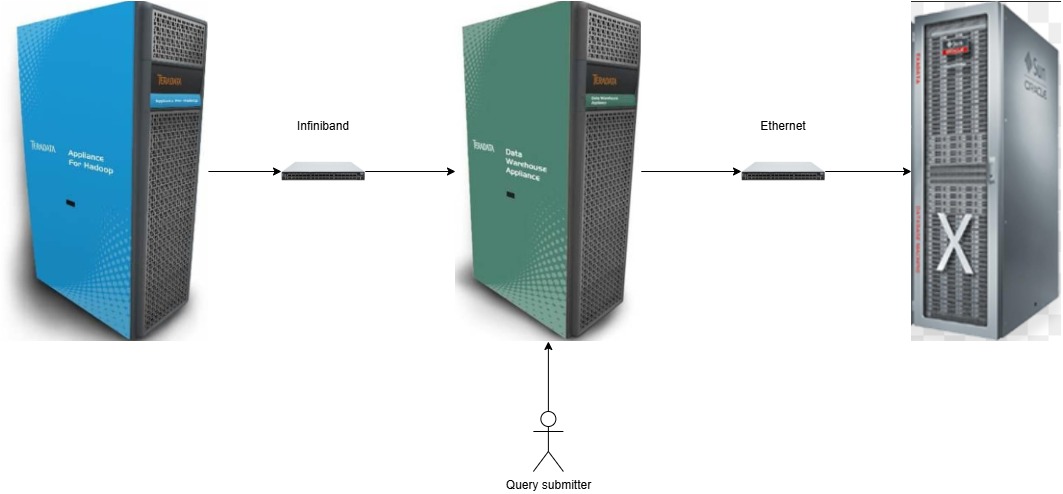
The setup included a Teradata database cluster, an Hadoop cluster, and an Oracle database.

With Teradata and Hadoop nodes connected over an Infiniband network it felt like nothing could stop me from sailing smoothly through the test workloads.
The feeling lasted just until I started to go beyond the functional tests.
With one of the client-provided queries retrieving 300,000,000 (three hundred millions) rows from Hadoop (for each execution) the account team and I quickly became aware of the scalability limits we faced even when working with an infrastructure that was undoubtedly top notch.
The volume of data that needed to be moved was not the only dimension that was pushing the limit of the architecture, but it was the most important of all.
This reality of querying distributed data sets is schematically summarized in the diagram below: the volume of data that needs to be moved can make a distributed architecture not viable.

I didn’t come up with this diagram until 2020: at the time I was in a meeting with my team mates in the AWS ASEAN analytics specialist solution architects (at the time lead by Raja) and we were discussing, among the other topic the recent announcement of Google’s BigQuery Omni running on Anthos.
There was a some concern among the colleagues that the new offering from Google might be a game changer and put us in a difficult spot.
I drafted the diagram to help us all put the announcement in the context of it intrinsic limits.
We were much more relaxed after using it to frame our reasoning.

The diagram above comes without unit of measure on the axis on purpose for two main reasons:
– each organization has a different technology landscape (source systems and interconnects) with different sustainable throughput and this would change the numbers
– the acceptable query response latency moves, ceteris paribus, the yellow curve closer or farther away from the X and Y axis

The careful reader will notice I haven’t mentioned commonly considered techniques to help reduce the load on the interconnection.
I’ll write about data caching and query push down in the next post.