Olivetti M10: amarcord purchase

When I was 11 I had my first programming training.
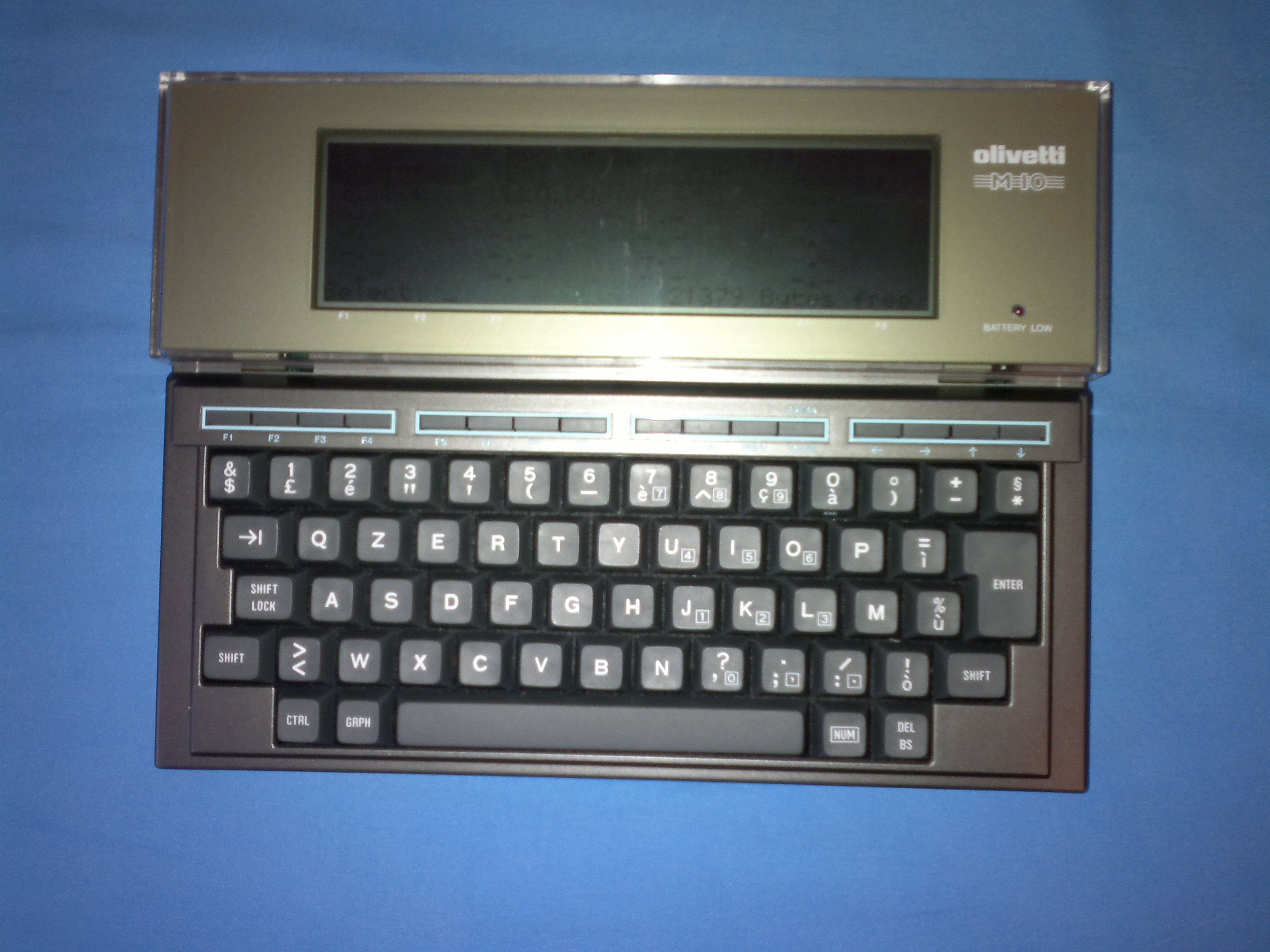
At the time computers were still a fairly esoteric subject in Italy, but my school had the opportunity to get a few Olivetti M10 when they were introduced and offered the opportunity to the students, on a voluntary basis, to be trained to use the systems.

30 years later I’ve decided to buy a piece of my computing history and now it’s part of my collection of old hardware.

Welcome home M10

2013-02-05-020

Asus EA-66N: a great little AP

After living for quite some time with the wi-fi built into the ADSL modems (I have two lines at  home) I’ve decided that the signal needed some improvement to work reliably with the Nexus 7.
For this reason, after reading a lot of reviews online I’ve selected this small device: it’s not the cheapest device for the purpose but I trust Smallnetbuilder

The design is unconventional and the size was surprisingly small when I got it.
The installation manual is relatively fat but it’s only because it covers a dozen different languages: the actual content is quite skinny; this fortunately is not an issue as the setup, once connected to the web interface, is really easy to do.

Signal improved significantly on the Nexus 7: from 1-2 tabs with some occasional complete disconnection to 4 bars (out of 4) with few drops to 3 bars.
Also the Nokia Lumia 800 and E7 both have shown a significant improvement in signal quality.
The Acer 3810T was already working fine with the older solution: this is likely due to the larger radio antenna and greater available power.

The device can be used also as a wi-fi to ethernet bridge to connect a single device implementing in an easy way what I did using OpenWRT and to extend the wi-fi range, but I’ve not used it in this way.

Overall I had a very positive experience and would suggest this device to anyone having a need like mine.

Synology DSVideo and mobile devices

This week I’ve made a few experiments with the video streaming capabilities of my DS411Slim NAS with two mobile platforms: a Nexus 7 (Android) and the Lumia 800 (WP 7.5).
In order to proceed I had to install the beta version on the NAS as a first step, then I was able to connect with the app downloaded from the stores of the two devices.

I only had a handful of old AVI movies to test and it turned out that the native player of both the Lumia and the Nexus 7 were unable to play the format.

On the Nexus 7 it was possible to install VLC and then play the video.
The same possibility is not available on the Lumia making it an unsuitable platform for further experiments.

The app on the Nexus is not able to resume the play from the point where the tablet was suspended and apparently doesn’t support the manual seek.
I’ve downloaded locally the file and VLC seek worked without any issue.

Overall the experience was fairly negative: DSVideo is not yet a mature solution.

Reading “Alone together” by Sherry Turkle: continued

Moving ahead reading proved that the first impression was correct:  the book is a great reading.

When I was getting close to the end of the first part, the one related to robots, I started to feel it hard to continue as reading was giving me a certain degree of discomfort somewhat similar to what I’ve experienced reading “A New Shoah: The Untold Story of Israel’s Victims of Terrorism” by Giulio Meotti.
It took me a while to realize the source of this feeling: the author was dismantling the mental barrier that protects me from the idea of having the robots in the future on the sale level as humans.

Gödel’s incompleteness theorems are the key pillar of my vision about what robots can’t do in the future and this was all I needed to dismiss the rise of the robots as a non-issue.
The challenge is that Sherry Turkle provides a lot of evidence of the fact that people is lowering the bar of what they feel is needed to accept the robots as relational manufacts.
No need to make them smart as humans leads to the ineffectiveness of the mathematical safeguard of Gödel’s incompleteness theorems: by lowering expectations robots will be able to match them in the near future.

You can take a look at Gödel’s incompleteness theorems on wikipedia (not the easiest of the journeys if you don’t have a bit of logic and algebra background) or read Douglas Hofstadter’s Gödel, Escher, Bach: An Eternal Golden Braid as an easier introduction.

OpenWRT on TP Link MR3420: easy and powerful

The house of my parent’s in law seems to have WiFi gremlins living inside.
Even obtaining a decent signal 8 meters from the router in the past proved to be a challenge.

As a first attempt to connect an old desktop of mine I tried a TP Link WiFi N PCI adapter (TL-WN751ND) with a single antenna (the best that was available in the nearby computer shop): the router signal was detected but connection always failed.

To improve the situation I’ve added a high(er) gain antenna (8db) with an extension cord: signal appeared significantly stronger but connection was still failing most of the time and when successful was lasting only a few minutes.

As a last attempt I decided to convert the 3G router that I already had from the stock firmware to the OpenWRT firmware and use it as a bridge providing ethernet connectivity to the desktop.
Installation was very simple as it worked from the standard firmware update interface of the stock firmware and in about 10 minutes I’ve had the bridge up and running.

Most likely the big challenge is related to signal scattering and the 2×2 MIMO did the needed magic.
Now the connection is fairly stable and I can get the full speed of the ADSL line to the desktop.

A big thank you to the OpenWRT guys.

New Nokia Lumia 800 at home: low satisfaction with WP

Recently my Nokia E7 died and I was left without a smartphone.

Given the nice feeling that I’ve had with the Nokia N9 I’ve picked up the Lumia 800 handset as the phone construction is very similar and the N9 was not longer available at a good price.

After one week of usage I’ve to say that I’m very unhappy with the phone because of the Windows Phone 7.5 operating system.

Microsoft made something major with WP that makes this OS worthless for me (and for people traveling a lot):
There it is no way I could find to download automatically (or by explicit command) all the email attachments for all the emails in my inbox.
I travel in foreign countries 50% of my time and I’m not always in free wifi coverage: having all the data in the phone up to the last synchronization time is key to make it a good work companion.
The position of MS is that the behavior is selected to avoid risks of infections and to help save bandwidth: I’d agree with the choice if it was just the default configuration but it’s not changeable at all.

BTW there it is people who is complaining about Android downloading attachments they’re never going to read 🙂

I’ll either hand the phone over to my wife or send it back hoping that I’ll get the E7 back from service soon as the physical keyboard is a big deal too for me.

Reading “Alone together” by Sherry Turkle

I’ve started to read this book and I’ve already found something worth sharing.

In the introduction a small but key statement is made about the fact that “to feel good is not the measure of everything” and that “we can feel good for the wrong reason”.

The author is not elaborating on this as if this would be a common agreement for any reasonable person.
I agree with her position about the criteria that should not be driving the behavior, but unfortunately this is not the general case: the ethic of selecting what makes feel good (or better) is shared by a lot of people.
And what is even worse is that is becoming more and more a short-term target: select what makes feel good now

If the first 20 pages are a good indication of what is to come it will be a good book

Italians should learn to complain less about their country

I’m working on a project in Germany for two weeks now and I’ll be here also next week.
I’ve found out that while Italians make a very good marketing of their products they make a fairly bad one of their own country.

A few examples from recent hands on experience.

3G coverage
I have a German 3G stick and on the train as soon as I’m 2km from the station the 3G signal is over and the 2G signal is not able to provide enough bandwidth for Skype chat.
In Italy it’s better even at my parent’s in law place and I consider that spot one of the worse.
Even with good 3G coverage at peak time it’s not better than a V.90 modem.
The colleagues told me this is normal.

Trains
Delay in the morning was the norm last week when I was getting in Hanover the high-speed train to Berlin.
On par or worse than the local train my wife takes to go to work.
A colleague confirmed that it was not a bad week. Today the same train was late too.

Highways
Traffic jams are there even in perfect weather condition and without road works: Italy has not an exclusive access to them.
Getting routed through 30 km of countryside roads to reach the highway to a major city happens here too.

Building standards
A colleague is having an experience very close to mine with a window not working well and water getting into the room on a recently built apartment.
Attorney and court fight is needed to get it right also in Germany.

Some colleagues had to commute 220 km (one way) each day this week as local hotels were not available and it was the most efficient way.
Like if for a project in Bologna a person had the hotel in Milano…

Berlin Tegel airport is connected only by a bus without a dedicated lane.
Traffic was heavy today: I was lucky taking an earlier train (that was late) that compensated the bus 🙂
My Nokia E7 died

Early in the monday morning I picked up my E7 to use it for both phone calls and as a GPS for my trip in Germany and I’ve found a bad surprise.
For no apparent reason it was asking me to insert the USB cable and then to disconnect the device no matter if I had or not something connected.
Acknowledging it was not helping: in a few seconds it was back with one of the two requests.
I’ve tried all the possible combinations suggested in this thread on nokia.com, but nothing worked.
I hope to get it fixed under warranty 😦

December update: I got it back fixed under warranty. Horray!

Corriere Telematico: an electronic magazine from my past

Exactly 19 years ago I started my earliest experiments writing about technology.
The Corriere Telematico was based on flat ascii file format with a reader that was able to jump to a specific article based on the line number in the file.
I believed that the content was lost given the fact that I was using BBSes at the time and the WWW was not in my horizon but this is not the case.

I wrote, with the nickname Satoru, about the way the cache worked in the early 386 system, about modems when high-speed interoperability was a dream (or a nightmare) due to the number of different standards on the market and about early consumer sound cards with wavetables.